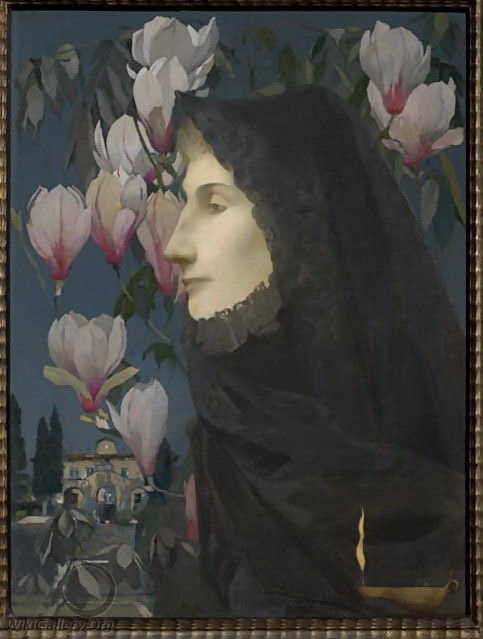
 Walburga, Lady Paget (May 3, 1839 – October 11, 1929) was a prominent Anglo-German aristocrat, diplomat's wife, author, and socialite who moved in the highest European
circles during the late 19th and early 20th centuries.
Walburga, Lady Paget (May 3, 1839 – October 11, 1929) was a prominent Anglo-German aristocrat, diplomat's wife, author, and socialite who moved in the highest European
circles during the late 19th and early 20th centuries.Queer Places:
Hotel Torre di Bellosguardo, Via Roti Michelozzi, 2, 50125 Firenze FI
St. Bartholomew's Churchyard, Church Ln, Tardebigge, Bromsgrove B60 3AH, United Kingdom
Walburga, Lady Paget (May 3, 1839 – October 11, 1929) was a prominent Anglo-German aristocrat, diplomat's wife, author, and socialite who moved in the highest European
circles during the late 19th and early 20th centuries.
Born Walburga Ehrengarde Helena von Hohenthal in Berlin, she was a member of the German noble House of Hohenthal. Before her marriage, she served as a lady-in-waiting to Victoria, Princess Royal (the daughter of Queen Victoria and mother of Kaiser Wilhelm II).
In 1860, she married the British diplomat Sir Augustus Berkeley Paget. Over the next several decades, she accompanied him on postings to Copenhagen, Florence, Rome, and Vienna.
While in Copenhagen, she famously helped facilitate the marriage between the Prince of Wales (the future King Edward VII) and Princess Alexandra of Denmark. She remained a lifelong, intimate friend of Queen Victoria.
Walburga and Gabrielle Borthwick (a pioneer in female motoring and an ambulance driver during WWI) were part of the same wealthy expatriate circle in Florence.
Their relationship was one of social acquaintance and friendship. Records show that Gabrielle was a guest at Lady Paget’s Villa Bellosguardo.
It is suggested that their connection may have been facilitated by shared interests in spiritualism or the Theosophical Society, with which both women were involved.
Lady Paget and the popular novelist Ouida (the pseudonym of Maria Louise Ramé) shared a complex, long-standing friendship centered in the Italian expatriate scene.
Lady Paget is widely considered to have served as the model for several of the heroines in Ouida's novels, most notably the protagonist in 'Pascarèl' (1873), which Ouida began shortly after meeting the Pagets in Rome.
As Ouida fell into financial hardship in her later years, Lady Paget proved to be a loyal friend. In 1906, she joined other prominent figures in successfully petitioning the British Prime Minister, Sir Henry Campbell-Bannerman, to grant Ouida a civil list pension of £150 per year to help the aging author survive.
After her husband retired and subsequently passed away in 1896, Lady Paget made her home at the Torre di Bellosguardo in Florence. There, she became a central figure in the expatriate community, known for her lavish hospitality and her advocacy for the preservation of historical Florentine architecture.
Lady Paget’s tenure at Hotel Torre di Bellosguardo represents the final, most defining chapter of her life as an independent hostess and social icon. After moving to the historic villa in the hills above Florence in the early 20th century, she transformed the property into a hub for European royalty, artists, and diplomats.
The villa, which dates back to the 13th century and was once owned by the noble Cavalcanti family, provided the perfect backdrop for Lady Paget's refined, albeit eccentric, lifestyle. She was deeply committed to the preservation of the villa's historical integrity, and her presence there contributed significantly to its status as a landmark of the Florentine expatriate scene.
Lady Paget famously held court at the villa, where guests included members of the British royal family and other prominent socialites. The villa was known for its sweeping views of Florence and its extensive, manicured gardens, which Lady Paget cultivated with great care.
During her time at the villa, she became an ardent campaigner for the protection of Florentine monuments. She frequently used her influence to challenge urban development projects that she felt threatened the historical character of the city.
Guests of the period often remarked on the villa’s mix of medieval grandeur and Lady Paget’s specific personal touches, including her interests in occultism and spiritualism, which infused her home life and the conversations she curated among her visitors.
The Hotel Torre di Bellosguardo continues to stand as a reminder of the era when figures like Lady Paget defined the social and intellectual life of Florence’s foreign elite.
Lady Paget was a committed (though not strict) vegetarian and an advocate for animal welfare, serving as a vice-president of the World League Against Vivisection. She was also deeply interested in spiritualism and the occult.
She authored several volumes of memoirs, including 'Scenes and Memories' (1912) and 'The Linings of Life' (1929). She died in 1929 at the age of 90 following an accidental fire at her home in England.
References:
Support this project
This website is a passion project researched, developed, and funded entirely by me. If you find the content valuable and would like to help support the ongoing research and hosting costs, any contribution is deeply appreciated.
Thank you for keeping this independent resource alive!
My books on Amazon: Elisa Rolle's books